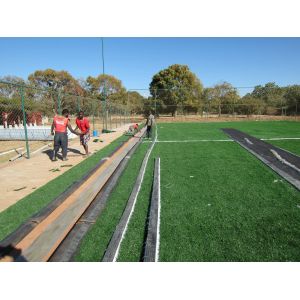
How to Maintain artificial turfs?
Routine maintenance of fake grass generally includes keeping the
surface clean of debris, especially that which may decay into the
synthetic lawn infill, and occasionally sweeping the fibers up to
revitalize the appearance of the lawn.
Rain is your best cleanser for your fake grass. Rainfall gently
cleans the fake grass turf fibers of dust, pollen and airborne
pollutants in way that is difficult to duplicate in any other
fashion. In areas where rainfall is scarce--or during prolonged
periods of drought--an occasional water flush is beneficial to soak
and thus cleanse the turf system. This procedure is recommended for
all synthetic lawn turf systems.
Here are some additional tips for your fake grass or synthetic lawn
product:
. Controlling the frequency of using artificial turf football
ground.
. Clearing the surface of artificial turf one or two times every
month.
• Do not use any tools that may damage the synthetic lawn and do
not use solvents like acetone or cleaning materials containing
alcohol.
• Pay special attention to the most heavily used areas of the
synthetic lawn. Keep extra sand or rubber infill as after a minor
settling period, you may wish to fill-in any minor “low spots”. If
you encounter a low spot on your synthetic lawn, take a bucket of
infill, locate the spot and apply several thin layers of infill to
the area and brush into the fibers with a stiff street broom or
small hand held fiber scrub brush (such as is used to hand scrub
floors). Brush in several directions.
• Every loose foreign object, no matter how small, can damage your
synthetic lawn by abrading the fibres and/or contaminating the
fill. Remove all leaves, twigs, paper, chewing gum, athletic tape,
bottles and any other waste items on a regular basis from your
synthetic lawn.
• To keep the infill from compacting and to limit the fibers from
“matting down”, brush your synthetic lawn on a regular basis.
Always brush the synthetic lawn in opposite directions, as
continuous brushing in one single direction will produce
unacceptable pile lean, with corresponding detrimental effects on
the playing characteristics. The less the synthetic lawn is swept,
the more it will need to be brushed.
• In case of seams opening, the synthetic lawn seams should be
repaired soon as quickly as possible to prevent the situation from
deteriorating.
• Snow removal: Generally snow and ice should be left to melt and
drain off the system without assistance. At times, however, it may
be desirable to remove snow or ice. If you elect to plow the snow,
leave a layer of snow of 1 inch as to protect your fake grass from
mechanical damage. The final layer of snow can be removed by
brushing the synthetic lawn.
• Do not park vehicles on the Synthetic Lawn. You also do not want
direct, hot engine exhaust to be discharged onto the Synthetic Lawn
for extended periods.
• Prevent lubricating oil, grease, transmission fluids, etc., from
dripping or spilling on your Synthetic Lawn surface during
sweepings. Such spills can discolor the Artificial Lawn. Battery
acid and other such fluids should not be allowed on the Synthetic
Lawn. Never change or add fluids to maintenance equipment while on
the Synthetic Lawn surface.
• The fake grass or artificial lawn fibers are highly stain
resistant because most stains are moisture borne and the
polyolefin-based fibers tend not to absorb moisture. Hence, most
stains on Synthetic Lawn are not true stains but rather residues of
foreign matter that must be promptly and thoroughly removed. Most
stains can be removed with water or soap and water. The first rule
is promptness. It is much easier to clean up a fresh spill before
it has time to dry and harden. Remove any solid or putty-like
deposit promptly using a dull knife or spatula-like tool.
• Neither long-term static load of more than 2 psi, nor any
transient or dynamic load of more than 35 psi should be allowed on
the synthetic lawn surface. The loading of a pneumatic-tired
vehicle is approximately equal to the air pressure in its tires.
Hence, it is good practice to eliminate any unnecessary long-term
parking and loading and to keep the necessary ones as low and brief
as possible.
• Enforce a smoke-free environment, if possible, and discourage the
use of fireworks, fires, and tobacco products including chewing
tobacco on or around the synthetic lawn